Friday, June 7, 2013

Reclaimed Realness: Pallet Furniture - Recycled, Stylish & Cheap

Pallet Furniture!
If you are looking for a low-cost, simple, and stylish solution for furniture; consider reclaimed pallets.

Turn this:

Into this:


With a little of this:

With today's economy and well just the price of stuff, I am constantly searching for economical ways to meet my client's needs without breaking their budgets.  One way to create a lot of furniture at a little cost is to use discarded construction pallets.  These are those rough wooden platforms you find under large products in warehouses.  They are often discarded upon delivery and are great for reuse.  If you live in an urban area they are especially easy to come across.  Craigslist is a good source or there are some places that even collect and sell them.  Your best bet is to ask the manager of a local hardware, storage/shipping warehouse, or grocery store if they have any pallets to spare.  With any luck you will have free materials to turn into just about anything you can imagine.

Some argue that pallets shouldn't be used for furniture because they're exposed to insects, rodents, weather, bacteria, etc.  That might be a an overzealous logic, however, just be reasonable about the pallets.  Be sure to wash and inspect them. If you're still nervous about potential harm then just stick to using pallets for outdoor projects.

Helpful hint: If you want to take the pallets apart, the easiest method is to use a SawZall or recipro saw to cut the nails. Pulling them is quite a task, and you tend to split more boards than you get off. If you don't want the nail heads, turn the board over and whack it on the ground, then punch the ones that are left.

Here is some inspiration:

 
Completely made from pallets with a custom slip cover and cushions
 
This great sofa is just two pallets on the floor 


This is my favorite pallet table with mosaic tile infill


Wall finish of pallet slats creates a rustic barn wood look

 
Super simple head board


Entertainment console and wine rack


Pallet pathway


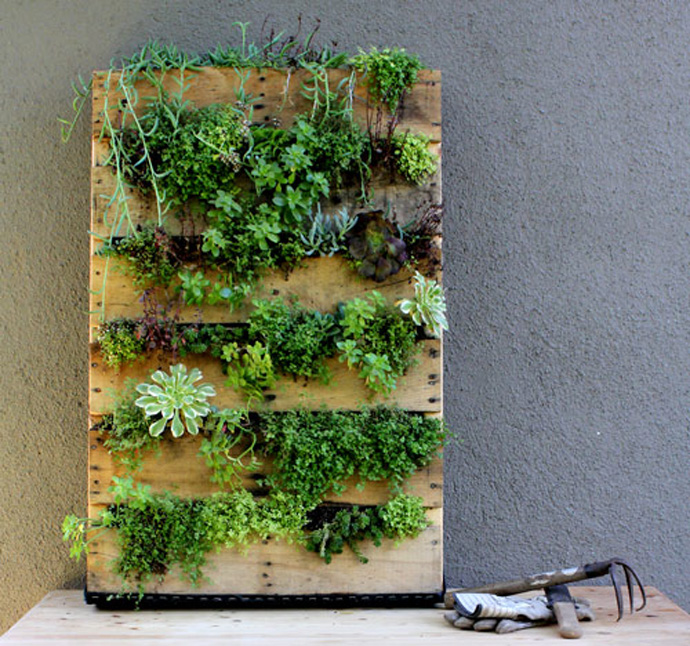
Pallet planter

 
Pallet stair with storage underneath.

 
Pallet barn, the slats spacing allows light and air to infiltrate the space.

 
These photos are of a pallet partition in a warehouse space used for a pop-up performance art space in Los Angeles


Or go all the way and make the whole house out of them!


Space Concept for The Still Bar


  • Space Concept

    The Still Bar, Los Angeles
    The concept for the space was inspired by the history of liquor craft in America.  From early traditions through prohibition, the artifacts and processes provide a rich and eclectic palette to create a space for today’s liquor connoisseurs.
    The exterior is completely redesigned to provide maximum visual street impact.  Curved black gun metal riveted panels allude to stills made by bootleggers in the early 1900s.  Red warehouse font signage is illuminated by a custom side light washing over the matte black plaster facade.   Louis Poulsen vintage inspired warehouse lighting provides illumination for the exterior patio seating which is separated from the interior space by a fully retracting copper clad folding door system.
    The interior space features a full sized bar area with a custom industrial inspired iron beer tap, gun metal bar front, distressed metal wall finish, and a custom gear-works kinetic sculpture housed in the backlit translucent bar top. All delicately illuminated by a custom copper pipe work lighting sculpture inspired by the drip of liquor from a still pipe.  An illuminated liquor shelf wraps the bar back and washes the wall with light passing through the liquor stored on glass shelving held by the copper pipe sculpture, along with a collection of vintage stills that are designed into the aesthetic of the bar.   The lounge area is appointed with a custom distressed leather Chesterfield banquette and custom whiskey crate tables with color changing LED under lighting.   The vault is defined by floor to ceiling custom copper clad backlit liquor cabinets accessed by a rolling library ladder.  A sculptural motorized lift and conveyor system delivers bottles of liquor right to the bar, while an extruded circular gun metal ceiling feature creates a stunning anchor for a hanging Edison chandelier. A vintage iron spiral stair leads guest to an intimate still inspired riveted metal tasting room nestled in the newly created mezzanine.  Finishes throughout evoke the feeling of liquor craft from copper penny tile, running bond subway tile, riveted distressed ironwork, antique copper, and distressed metal.
  • Concept Boards

  • Final interior renderings from design model by Josef Giwargis

    • Design Model

    • Partial Floor Plan

    • Section


    • Interior Perspective

    • Interior Perspective

The Story Circle Sculpture Installed!


Announcing the completion of the Story Circle Sculpture:

Part of a competition based selection process, this project is a design collaboration with the Social Design Collective for a public art work in the City of Santa Ana California. The Story Circle Sculpture integrates community vision into the built landscape by establishing public space's function as a center point of community convergence. The design was part of a community-driven public practice created to engage both the client and the community in achieving responsible, sustainable, and mutually beneficial solutions. The goal was to create public art that is durable, functional, and aesthetically pleasing while implementing supplemental progressive cultural, art, and communal programs.

The concept of the story circle and its engagement with the neighborhood was conceived by Jules Rochielle, founder of The Social Design Collective. Designer Chad Clark of Defying Gravity Studio transformed the concept into a form inspired by seed pods, a symbol of growth and knowledge. The forms were sculpted to create a beautiful and intimate story circle seating area where the seeds of knowledge are planted as the story teller sits in the large chair while children from the neighbor sit, listen, and learn. Christina Sanchez, Artist, Educator, and Activist, worked to create a new supplementary arts curriculum benefiting 700 students at Garfield Elementary School which is located across the street from the Story Circle Sculpture and whose students have limited access to an arts education.


The Story Circle Sculpture is part of the Triada Court component of the new Station District public housing developed by Related California, Griffin Realty Corp., and Affordable Housing Access in cooperation with the City of Santa Ana. The residential development will provide high quality affordable housing for low-income large families under the city’s new Transit Zoning Code which promotes transit-oriented development in the area surrounding the Santa Ana Regional Transportation Center. The Story Circle is located at street level and is viewable/accessible to the neighborhood and nearby Garfield Elementary School. The sculpture itself is a public seating arrangement of custom cast fiberglass set on a 7' diameter concrete and tile base. The fiberglass is infused with bronze powder giving it the look of real cast bronze at a fraction of the cost, while a bronze penny tile surface under the sculpture reinforces of the concept of seeds of knowledge. The final result was a durable, lightweight and cost effective solution which was easy to transport 

and install and will serve the neighborhood for years to come.


“The Triada Court is an excellent example of the City’s efforts to match beautiful housing options for our residents at an affordable price, which promotes our community’s vision and revitalizes the neighborhood. The inclusion of neighborhood retail, child care and public art features as part of the project also reflect the needs and desires of the community” -- Mayor Miguel Pulido


Special Thanks to:
Scott Callison, Callison Contrating - Vahik Kazarian, StoneArt Inc. (Fiberglass fabrication) - Tracy Caris, Ann Sacks (Tile supplier) - Tomoko Matsushita, Tphotography - Sandi Gottlieb, Program Manager, Community Development Agency - Linda DeLeon, Garfield Elementary School - Martin Gantman (Structural Engineer) - Marie Debor, Project Manager, Related California

Thursday, May 16, 2013


The Positive Impact of Art in Healthcare Facilities
By Kristen Avis

From Designbuildsource


Modern healthcare facilities are being transformed from sterile buildings into places that make patients feel calm and promote healing, with art playing a monumental role.

Incorporating various types of art into healthcare facilities has been shown to positively impact the health outcomes of patients across the globe. Art helps to boost patients in their physical,emotional and mental recovery by inducing feelings of relaxation and decreasing anxiety and perceptions of pain.

“It’s the whole emotional and perceptual context you are in. When you’re in a hospital it’s high stress. When we are stressed, we go back to our primal need to be soothed,” said Upali Nanda, vice president and director of research for American Art Resources, a healthcare art consulting firm in Houston.

Having completed a doctorate in architecture, specialising in healthcare systems and design, Nanda says art can aid in recovery, shorten hospital stays and assist with pain. She stresses that friendly faces, vivid landscapes and familiar objects help to lower blood pressure and heart rate while abstract images can have the opposite effect.


Royal Children Hospital. Image Source: Art Scape International

Such practice is hardly new, dating back at least as far as 1859 through the vision of English social reformer Florence Nightingale.

“Variety of form and brilliancy of colour in the objects presented to patients have a powerful effect and are actual means of recovery,” she said at the time, and these words have obviously affected the modern approach to healthcare.

In the past, abstract artwork was often used, but there is a growing trend toward using pieces that are more realistic. A study in Swedish hospitals showed that tranquil images helped to relax staff and patients which resulted in patients recovering more quickly.

Numerous research studies dealing with patient healing and arts focus on architecture and design issues. Along with art such as paintings, photographs and murals, the physical design of healthcare units can greatly contribute to patient outcomes.


Royal Children Hospital. Image Source: Art Scape International

Fortunately for patients and healthcare workers, there has been a real movement lately toward bringing building users into the centre of the design with the aim of enhancing the overall experience of recovery or care.

Royal Children’s Hospital, Melbourne, Australia

Designers of the Royal Children’s Hospital in Melbourne have tried to counteract the unpleasant reality of hospital stays with an abundance of artwork to ease the minds of young patients.

The atrium at the junction of the outpatients department is home to a 14-metre colourful sculpture called the ‘Creature.’ A large mobile piece of five butterflies called ‘Sky Garden’ hangs above the sculpture.


Royal Children Hospital. Image Source: Art Scape International

Design firm Buro North focused on designing around navigation and east way-finding in much of the hospital using over 5,000 signs, wall panels and landmarks.

The sculptures and murals bring animation and colour to the interior in order to remind patients of the positive things in life.

Mount Sinai Hospital, New York City

The Mount Sinai Division of Pediatric Hematology in New York commissioned the services of Splashes of Hope in 2005 to renovate the hospital’s outpatient facility.

Chemotherapy treatments were previously done in a sterile environment which they turned into a haven of artwork overnight. Murals of New York City were painted on the walls in an effort to make patients feel at home.

The hospital’s teen room, play room and pediatric infusion room are covered in a cityscape with familiar Manhattan structures including the hospital itself to stress the importance of a place that patients can call home.

Montefiore Hospital, Brighton, UK

Montefiore Hospital Brighton. Image Source: World Architecture News

The coastal community of Brighton, UK is home to healthcare architecture specialists IBI Nightingale’s recently completed Montefiore Hospital.

The project involved turning a former Victorian storehouse and office building into a modern, private hospital. It was quite a challenge to meet the operational requirements while also maintaining the character of the Victorian building, but the result is a gorgeous facility that guests say feels more like a boutique hotel than a hospital.

IBI Nightingale, in collaboration with Spire Healthcare, was joined by musician and artist Brian Eno who designed two light and sound installations to be integrated into the building’s design.


Montefiore Hospital Brighton. Image Source: World Architecture News

Eno’s artwork includes a reworking of his 77 Million Paintings piece. The hand-drawn and computer generated images were framed and hung in a grid in the lobby of the new hospital.

The artwork is matched with soft background music composed by Eno to allow patients to relax and escape the reality of hospital life.

A downstairs chemotherapy room branches off to a larger relaxation area called the ‘Quiet Room for Montefiore,’ which was conceived by Eno. There, he created a private, quiet space for patients and staff to relax and unwind. The room’s use of gentle music and warm lighting have been proven to lower the heart rates of those inside, offering evidence of its calming nature.


Montefiore Hospital Brighton. Image Source: World Architecture News

The Montefiore treats a mix of public and private patients and is a model of thoughtfully incorporating art into the building design, leading the way for healthcare architecture in the UK.

Friday, May 3, 2013

Story Circle Sculpture - Fabrication is Complete

The Collaboration with Social Design Collective for the Story Circle Sculpture at Triada Court in Santa Ana is just about ready to install.  The fiberglass pieces are finished and being polished today.  The fiberglass is infused with bronze powder which gives the pieces the appearance of cast bronze for a fraction of the cost and weight.  I am super pleased with the outcome.  The fiberglass sculpture was refined and fabricated by Vahik Kazarian of StoneArt Inc.

The concrete foundation is being poured on the site in Santa Ana and we hope to install the sculptures in a week or so.  Installation photos to follow.


                              This is a bench for children on which to sit and hear stories


 This is the story-teller's chair


Wednesday, April 24, 2013

9 ways that sound affects our health, wellbeing and productivity


From TED.com
Julian Treasure cares very deeply for your ears. That’s why he’s given TED talks like “The 4 ways sound affects us” and “Why architects need to use their ears.” Treasure is on a mission to make policymakers, engineers, architects and, we
ll, Julian Treasure: Shh! Sound health in 8 stepseveryone think more about what they hear around them — because the way things sound have a tangible, measurable effect on how we feel, how we heal, how we work and how we live.


To this end, Treasure’s The Sound Agency has teamed up with Biamp Systems to create a whitepaper called “Building in Sound,” a look at the data linking sound and well-being.


“This paper is based on exhaustive review of academic papers, and reports from national governments and multinational bodies, going back some 40 years,” it begins. “The research examines the causes and impacts of sound on our health, recovery from illness or surgery, our ability to absorb information and learn, our productivity, and general sense of wellbeing.”


Read the paper in full, or check out some of the most fascinating facts below.
The estimated cost of noise pollution is $30.8 billion a year — and that’s just in Europe. The World Health Organization Europe’s 2011 report, “Burden of disease from environmental noise,” analyzes the relationship between environmental noise and health. In this study, they calculate the financial cost of lost work days, healthcare treatment, impaired learning and decreased productivity due to noise. The total they came up with is staggering, considering they’re looking at just one continent.
.
Each year, noise pollution takes a day off the life of every adult and child in Europe. This same study also looked at the cost of noise pollution in terms of lost life expectancy. Shockingly, they determined that every 365 days, one million years are taken off European’s collective life expectancy — averaging to a day per person.
.
If you can hear someone talking while you’re reading or writing, your productivity dips by up to 66%. Open floor-plan offices distract workers without them even noticing it. In a classic studypublished in the British Journal of Psychology in 1998, researchers found that employers were highly distracted when they could hear conversation around them, and less able to perform their duties. Another classic study found that noise in the office also correlated to increased stress hormone levels and a lower willingness to engage with others. According to Sound Agency case study, when sound masking technology was used in an office, there was a 46% improvement in employees’ ability to concentrate and their short term memory accuracy increased 10 percent.
.
The average noise level in many classrooms is not just associated with impaired learning — but with permanent hearing loss. Noise can deeply affect learning too. The WHO recommends a noise level in classrooms akin to that you’d find in a library — 35 decibels. However, a study in Germany found that the actual average noise volume in classrooms is 65 decibels — a level associated with permanent hearing loss. As Treasure outlines in this talk, for a student sitting in the fourth row of a traditional classroom, speech intelligibility is just 50 percent — meaning that they only hear half of what their teacher says.
.
A 20 decibel increase in aircraft noise is enough to delay a student’s reading level by up to 8 months. A study published in the American Journal of Epidemiology in 2006 looked at 2000 students between the ages of 9 and 10 in schools in The Netherlands, Spain and the U.K. — many in schools near airports. They found that aircraft noise was associated with impaired reading comprehension.
.
50% of teachers have experienced damage to their voice from talking over classroom noise.A study of teachers published in the Journal of Speech, Language and Hearing Research in 2004, noted another side-effect of noise pollution in classrooms — 50% of teachers have suffered irreversible damage to their voices. Why? Because as the environment gets noisier, we speak more loudly.
.
The average noise level in some hospital wards not only impedes healing — but could legally require hearing protection. The WHO recommends noise levels in hospital wards to stay around 35 decibels. But a study in the US found the average noise level in hospital wards is actually closer to 95 decibels — just 10 decibels beyond the noise level at which U.S. federal law requires ear protection for prolonged exposure. Sleep is crucial for patient recovery, and yet with the constant beeps, tones and shuffling, the body feels that it is under threat. Not to mention that staff errors increase the greater the level of distracting noise.
.
3% of cardiac arrest cases in Germany have been explicitly linked to traffic noise. Treasure found this alarming fact in a 2009 press release from the Environmental Protection UK.
.
Noise pollution may possibly even contribute to crime. When the city of Lancaster, California, installed a sound system featuring birdsong along a half-mile stretch of a main road, there was a 15 percent reduction in reported crime, according to an article in The Wall Street Journal. Similarly, when the London Underground started playing classical music at a crime-heavy station, robberies fell by 33% while assaults on staff dropped 25%, says The Independent.